Bellaire's founding story is a small piece of railroad history. In 1908, William Wright Baldwin — president of the Chicago, Burlington & Quincy Railroad — acquired a stretch of the old Rice ranch southwest of Houston and platted a townsite he named for the breezes off the Gulf, echoing Bellaire, Ohio. An interurban streetcar line connected it to Houston, and a community took root six miles from a city that would eventually surround it entirely without ever absorbing it.
That last part matters. Bellaire incorporated in 1918 and remains an independent city, one of the enclave municipalities inside Houston's boundaries with its own mayor, council, police, fire, and parks department. Residents describe a small-town operating system running inside a metropolis of seven million, and they are not wrong.
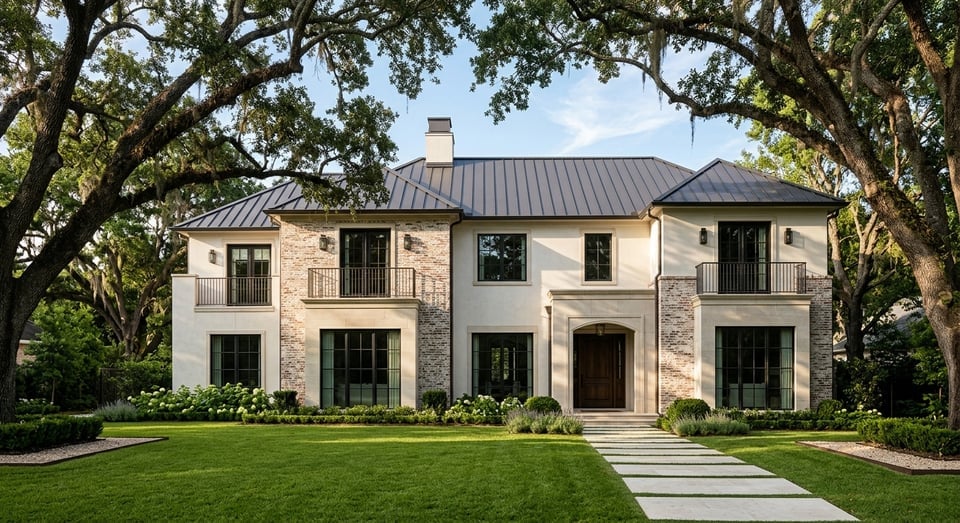
The built environment has turned over substantially. The original 1940s and 1950s ranch homes on wide, flat lots have given way over three decades to custom construction — traditional, French, Mediterranean, and a rising share of transitional and modern designs, often with third-floor game rooms, elevators, and deep backyards that older Inner Loop neighborhoods simply cannot offer at the same lot width. The result is one of the more interesting value equations in central Houston: newer square footage, larger yards, and a genuinely central location.
Civic life centers on Bellaire Town Square, with its recreation center, aquatics complex, and library. Evergreen Park and the Nature Discovery Center at Russ Pitman Park — nearly six acres of restored woodland with a nature house — give the city a green identity out of proportion to its size. The Fourth of July parade down Bellaire Boulevard is a genuine institution.
Location is Bellaire's quiet superpower. The Texas Medical Center is roughly ten to fifteen minutes east via Bellaire Boulevard or Holcombe. The Galleria and Uptown are a similar run north on the 610 West Loop. Downtown is about twenty. The 610 and 59/69 interchange puts most of the metro within reasonable reach.
Bellaire has never traded on flash. It trades on space, autonomy, and a location that keeps proving itself — which is why the market here has been remarkably durable across cycles.
17,125 people live in Bellaire, where the median age is 45.1 and the average individual income is $112,471. Data provided by the U.S. Census Bureau.
Total Population
Median Age
Population Density Population Density This is the number of people per square mile in a neighborhood.
Average individual Income
There's plenty to do around Bellaire, including shopping, dining, nightlife, parks, and more. Data provided by Walk Score and Yelp.
Explore popular things to do in the area, including Aesthetic Specialists of Houston, Hanh Le, and John E. Yeager Jr.
| Name | Category | Distance | Reviews |
Ratings by
Yelp
|
|---|---|---|---|---|
| Beauty | 0.19 miles | 0 reviews | 0/5 stars | |
| Beauty | 0.38 miles | 0 reviews | 0/5 stars | |
| Beauty | 0.54 miles | 0 reviews | 0/5 stars | |
| Beauty | 0.58 miles | 1 review | 5/5 stars | |
| Beauty | 1.09 miles | 0 reviews | 0/5 stars | |
|
|
||||
|
|
||||
|
|
||||
|
|
||||
|
|
||||
|
|
Bellaire has 6,192 households, with an average household size of 2.76. Data provided by the U.S. Census Bureau. Here’s what the people living in Bellaire do for work — and how long it takes them to get there. Data provided by the U.S. Census Bureau. 17,125 people call Bellaire home. The population density is 4,703 and the largest age group is Data provided by the U.S. Census Bureau.
Total Population
Population Density Population Density This is the number of people per square mile in a neighborhood.
Median Age
Men vs Women
Population by Age Group
0-9 Years
10-17 Years
18-24 Years
25-64 Years
65-74 Years
75+ Years
Education Level
Total Households
Average Household Size
Average individual Income
Households with Children
With Children:
Without Children:
Marital Status
Blue vs White Collar Workers
Blue Collar:
White Collar: