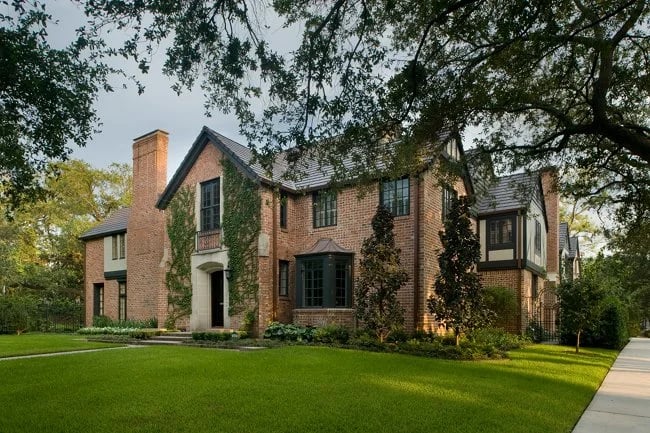
If you have ever driven North or South Boulevard beneath the live oaks and slowed down without meaning to, you already understand this part of Houston.
The area covering Southampton Place, Broadacres, and Boulevard Oaks was platted in the 1920s as Houston's professional and academic class settled around the newly opened Rice Institute. Broadacres, laid out in 1923 with landscape and planning input from architect William Ward Watkin — Rice's founding architecture faculty member — remains one of the most accomplished pieces of residential planning in the state. The double rows of live oaks along its esplanades were planted with a hundred-year view. They arrived.
The architecture is the draw. John F. Staub, Birdsall Briscoe, Watkin himself, and their contemporaries built here in Georgian, Italianate, Tudor, Spanish Colonial, and Mediterranean vocabularies, on lots deep enough to hold them properly. Boulevard Oaks and Broadacres both carry historic district protections, which is why the streetscape reads today much as it did eighty years ago. Interiors have been renovated relentlessly and often brilliantly — plaster and millwork preserved, kitchens and systems brought fully current, pool houses and studios added at the rear.
The setting is the other draw, and it is difficult to overstate. Rice University's campus is across the street. Hermann Park — with the Japanese Garden, McGovern Centennial Gardens, Miller Outdoor Theatre, and the Houston Zoo — is a few blocks east. The Museum District's nineteen institutions begin at the northern edge: the Museum of Fine Arts, Houston with its Steven Holl–designed Kinder Building, the Menil Collection campus, the Rothko Chapel, the Contemporary Arts Museum, the Houston Museum of Natural Science.
And the Texas Medical Center is immediately south. For those whose professional lives are anchored there, few Houston addresses combine this quality of architecture with this length of commute — frequently under ten minutes, and for some, a bicycle ride.
Rice Village and the restaurants of Montrose and Upper Kirby are minutes away. Downtown is a straight run up Main Street, with the METRORail Red Line running the same corridor.
This is Houston at its most European in feel and most rooted in fact — a place where the trees, the buildings, and the institutions have all been growing together for a century.
7,595 people live in Southampton & Boulevard Oaks, where the median age is 42 and the average individual income is $152,933. Data provided by the U.S. Census Bureau.
Total Population
Median Age
Population Density Population Density This is the number of people per square mile in a neighborhood.
Average individual Income
There's plenty to do around Southampton & Boulevard Oaks, including shopping, dining, nightlife, parks, and more. Data provided by Walk Score and Yelp.
Explore popular things to do in the area, including Winter Michael D, Houston Iyengar Yoga Studio, and The Bodhi Tree Spa.
| Name | Category | Distance | Reviews |
Ratings by
Yelp
|
|---|---|---|---|---|
| Active | 0.87 miles | 0 reviews | 0/5 stars | |
| Active | 0.94 miles | 0 reviews | 0/5 stars | |
| Beauty | 0.88 miles | 0 reviews | 0/5 stars | |
|
|
||||
|
|
||||
|
|
||||
|
|
||||
|
|
||||
|
|
Southampton & Boulevard Oaks has 3,331 households, with an average household size of 2. Data provided by the U.S. Census Bureau. Here’s what the people living in Southampton & Boulevard Oaks do for work — and how long it takes them to get there. Data provided by the U.S. Census Bureau. 7,595 people call Southampton & Boulevard Oaks home. The population density is 7,361 and the largest age group is Data provided by the U.S. Census Bureau.
Total Population
Population Density Population Density This is the number of people per square mile in a neighborhood.
Median Age
Men vs Women
Population by Age Group
0-9 Years
10-17 Years
18-24 Years
25-64 Years
65-74 Years
75+ Years
Education Level
Total Households
Average Household Size
Average individual Income
Households with Children
With Children:
Without Children:
Marital Status
Blue vs White Collar Workers
Blue Collar:
White Collar: