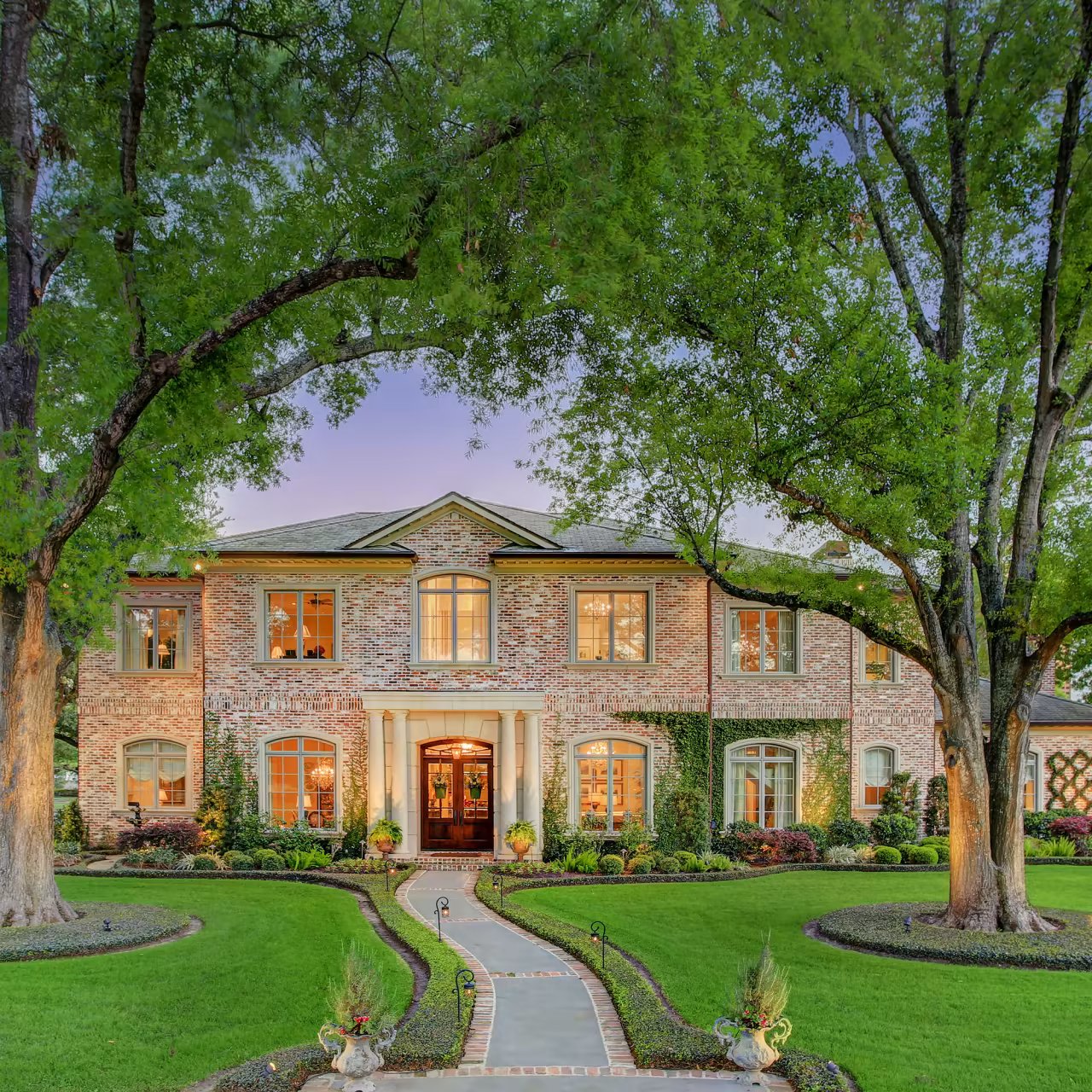
Tanglewood was William Farrington's answer to a simple question: what if you took River Oaks' generosity of scale and set it down where the city was actually going?
Development began in 1949 on land that was then well outside Houston proper. Farrington platted deep lots, laid esplanades down the center of Tanglewood Boulevard, and planted the oaks that now form the neighborhood's signature green tunnel. He was, as it turned out, extremely well positioned. Two decades later Gerald Hines opened the Galleria a few blocks east, modeled on Milan's Galleria Vittorio Emanuele II, and the pasture west of the Loop became Uptown Houston — a business and retail district that would outgrow the downtowns of most American cities.
Tanglewood absorbed that change without losing its composure. The streets remain residential and quiet. The lots remain wide. The homes have evolved — original ranches steadily replaced by substantial custom construction in traditional, French, and transitional vocabularies, many with motor courts, pool houses, and the kind of interior finish work that rewards a slow walkthrough. The Bush family lived here for years, which tells you something about the neighborhood's temperament: consequential, but not loud about it.
The location is close to unbeatable. The Galleria's four levels hold Saks, Neiman Marcus, Cartier, Louis Vuitton, and the ice rink that has entertained three generations of Houstonians. The Post Oak Hotel — Tilman Fertitta's Forbes Five-Star tower — brings Mastro's and a Rolls-Royce showroom to the same address. Nobu, Steak 48, and a dense field of accomplished restaurants sit within a five-minute drive. The Gerald D. Hines Waterwall, sixty-four feet of cascading water at the foot of Philip Johnson's Williams Tower, anchors a small park that remains the neighborhood's favorite photograph.
For all that proximity, Tanglewood's interior streets stay genuinely calm. Tanglewood Park and the boulevard esplanades give the neighborhood its own green, and the Memorial Park trail system is a short drive north.
Downtown is fifteen minutes. The Texas Medical Center is roughly twenty. And the Galleria is close enough that residents have been known to walk over for a haircut and come home with something from Hermès.
3,189 people live in Tanglewood, where the median age is 61 and the average individual income is $139,495. Data provided by the U.S. Census Bureau.
Total Population
Median Age
Population Density Population Density This is the number of people per square mile in a neighborhood.
Average individual Income
There's plenty to do around Tanglewood, including shopping, dining, nightlife, parks, and more. Data provided by Walk Score and Yelp.
Explore popular things to do in the area, including Louis Capital Markets, Flava House, and Veneno Tequila.
| Name | Category | Distance | Reviews |
Ratings by
Yelp
|
|---|---|---|---|---|
| Dining | 0.76 miles | 0 reviews | 0/5 stars | |
| Dining | 1.01 miles | 0 reviews | 0/5 stars | |
| Dining | 1.01 miles | 0 reviews | 0/5 stars | |
| Dining | 1.13 miles | 0 reviews | 0/5 stars | |
| Dining | 1.17 miles | 0 reviews | 0/5 stars | |
| Shopping | 1.22 miles | 0 reviews | 0/5 stars | |
| Shopping | 1.51 miles | 1 review | 5/5 stars | |
| Active | 0.96 miles | 0 reviews | 0/5 stars | |
| Active | 1.17 miles | 0 reviews | 0/5 stars | |
| Active | 1.39 miles | 0 reviews | 0/5 stars | |
| Beauty | 0.68 miles | 0 reviews | 0/5 stars | |
| Beauty | 0.78 miles | 0 reviews | 0/5 stars | |
| Beauty | 0.88 miles | 6 reviews | 4.5/5 stars | |
| Beauty | 0.95 miles | 0 reviews | 0/5 stars | |
| Beauty | 0.95 miles | 0 reviews | 0/5 stars | |
| Beauty | 1.03 miles | 0 reviews | 0/5 stars | |
| Beauty | 1.1 miles | 0 reviews | 0/5 stars | |
| Beauty | 1.21 miles | 0 reviews | 0/5 stars | |
| Beauty | 1.27 miles | 0 reviews | 0/5 stars | |
| Beauty | 1.27 miles | 1 review | 1/5 stars | |
| Beauty | 1.42 miles | 81 reviews | 3.6/5 stars | |
| Beauty | 1.42 miles | 0 reviews | 0/5 stars | |
| Beauty | 1.45 miles | 7 reviews | 5/5 stars | |
| Beauty | 1.53 miles | 0 reviews | 0/5 stars | |
|
|
||||
|
|
||||
|
|
||||
|
|
||||
|
|
||||
|
|
Tanglewood has 1,257 households, with an average household size of 2. Data provided by the U.S. Census Bureau. Here’s what the people living in Tanglewood do for work — and how long it takes them to get there. Data provided by the U.S. Census Bureau. 3,189 people call Tanglewood home. The population density is 10,525 and the largest age group is Data provided by the U.S. Census Bureau.
Total Population
Population Density Population Density This is the number of people per square mile in a neighborhood.
Median Age
Men vs Women
Population by Age Group
0-9 Years
10-17 Years
18-24 Years
25-64 Years
65-74 Years
75+ Years
Education Level
Total Households
Average Household Size
Average individual Income
Households with Children
With Children:
Without Children:
Marital Status
Blue vs White Collar Workers
Blue Collar:
White Collar: